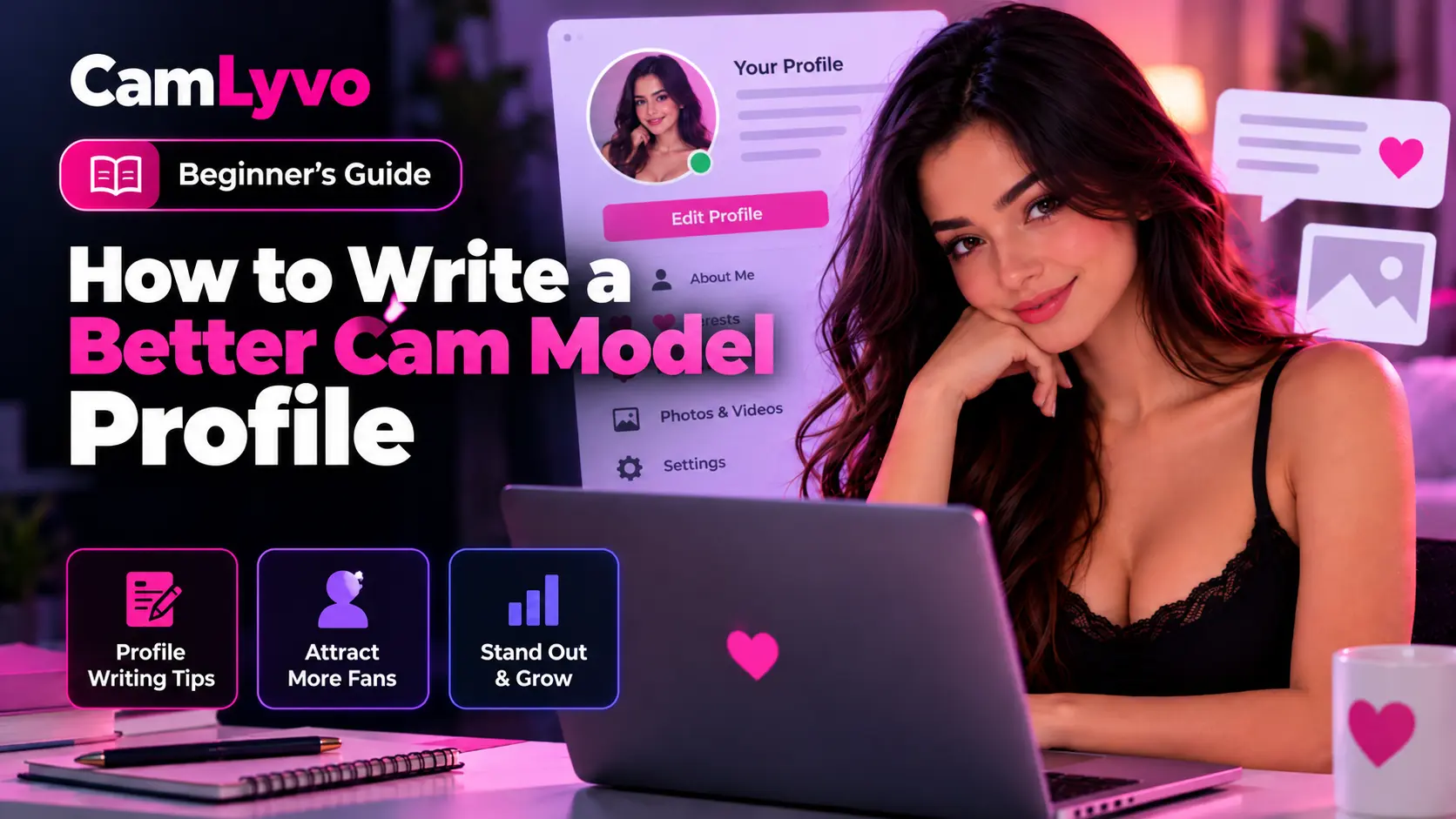
A good cam model profile does not need to be complicated, exaggerated or packed with personal information.
Its job is much simpler: help visitors quickly understand your public stage identity, what kind of experience or atmosphere you intend to create, and whether your profile appears active and intentional.
For beginners, the best profile is usually one that is clear, privacy-conscious and easy to maintain.
If you are still preparing to apply, start with our How to Become a Stripchat Model guide. If your account is already set up, this guide will help you improve the public-facing profile itself.
Affiliate disclosure: CamLyvo may earn a commission from eligible referrals made through certain links on this site. This does not change the editorial guidance in this article. See our Affiliate Disclosure.
What Is a Cam Model Profile Supposed to Do?
A profile should answer a few basic questions for a visitor without forcing them to search through unnecessary information.
- Who is this creator presenting themselves as?
- What kind of personality or atmosphere should I expect?
- Is the profile active and maintained?
- Is there useful information about availability or interests?
- Does the profile feel consistent?
A profile does not need to explain your entire personal life.
In fact, from a privacy perspective, sharing less but making that information more intentional can be a better strategy.
Start With a Clear Stage Identity
Your stage identity is the public version of yourself that viewers will associate with your profile.
It can include your stage name, profile image, writing style and the overall way you describe yourself.
The goal is consistency.
If your stage name sounds playful but your profile reads like a formal business document, the experience may feel disconnected. If your profile presents one personality while your public interactions consistently present another, the profile may also feel less authentic.
You do not need to invent an elaborate character. A simple and consistent public identity is easier to maintain.
Choose a Stage Name With Privacy in Mind
A stage name can help separate your public creator identity from unrelated parts of your private life.
Before choosing or reusing a username, search your own online presence and consider whether the same name is already strongly connected to personal accounts.
Try to avoid unnecessary connections such as:
- reusing a personal social-media username,
- including your full legal name,
- using a username that contains your birth year,
- including a workplace, school or precise location, or
- copying an identifying username used on unrelated private accounts.
This is a privacy recommendation, not a suggestion to provide inaccurate legal information where a platform requires identity verification.
For more privacy preparation, see our Stripchat Model Safety & Privacy Guide.
Write a Bio That Is Easy to Scan
A profile bio should not feel like a wall of text.
A beginner-friendly structure is:
- a short introduction,
- a few personality or interest details,
- what visitors can generally expect from your public presence, and
- any useful schedule or availability information you can realistically maintain.
That is usually enough to create context without oversharing.
A Simple Cam Model Bio Framework
| Section | Purpose |
|---|---|
| Opening | Introduce your stage identity in one or two lines |
| Personality | Mention a few public-safe interests or traits |
| Experience | Describe the general atmosphere or interaction style you want to create |
| Availability | Add a schedule only if you can keep it reasonably current |
The structure matters more than making the bio long.
Example of a Simple Profile Bio
Hi, I’m Luna. I’m friendly, talkative and usually here for relaxed conversations and a fun atmosphere. I enjoy music, movies and getting to know regular visitors. I’m still building my routine, so check my profile for current availability.
This example is intentionally simple.
It communicates personality and expectations without providing a home location, legal name, workplace or other unnecessary identifying details.
Do Not Fill the Bio With Keywords
Your profile is written primarily for people, not a search engine.
Repeating the same phrases again and again makes a profile difficult to read and can make it feel artificial.
Instead of writing:
New cam model, best cam model, friendly cam model, live cam model, online cam model...
write naturally about who you are presenting yourself as and what visitors can expect.
Clear writing is more useful than keyword repetition.
Use Specific Personality Details Without Oversharing
Generic descriptions such as “fun and friendly” are fine, but a small number of safe details can make a profile more memorable.
For example:
- music genres you enjoy,
- movies or games you like,
- general hobbies,
- a favorite type of conversation, or
- your general personality style.
Choose details that help create a public identity without exposing information you would rather keep private.
There is rarely a need to include your exact neighborhood, employer, school or daily physical location.
Be Honest About What You Can Maintain
A profile can become less useful when it promises things that are not consistently true.
For example, avoid presenting a fixed schedule if you know you cannot maintain it.
If your availability is still changing, simple wording may be better:
My schedule is still evolving. Check the profile for current availability.
When you eventually develop a consistent routine, you can update the profile with more specific information.
Use a Profile Image That Matches Your Public Identity
Your profile image is often one of the first elements a visitor notices.
The image does not need to be professionally produced, but it should be intentional.
Before using an image, check:
- whether the subject is clear,
- whether the lighting is usable,
- whether the background is distracting,
- whether private documents or location clues appear in the image, and
- whether the image fits the stage identity used elsewhere on the profile.
Our Beginner Cam Setup Guide covers lighting, camera positioning and background privacy in more detail.
Check the Background of Profile Photos
People often review themselves in a photo and forget to inspect everything behind them.
Before uploading, zoom in and look for:
| Background Detail | Possible Issue |
|---|---|
| Mail or packages | Name or address exposure |
| Work or school logo | Identity or location clue |
| Family photographs | Other people's privacy |
| Computer screen | Private messages or names |
| Mirrors | Unexpected parts of the room may be visible |
| Windows | Potential location clues |
This check should become routine for both profile images and future uploaded content.
Keep Your Profile Easy to Read
A visitor should be able to scan your profile without working through a large block of text.
Use:
- short paragraphs,
- clear sections where available,
- simple wording,
- consistent capitalization, and
- only the information that helps the visitor understand your public profile.
Avoid excessive symbols, repeated punctuation or long sections written entirely in capital letters.
Decide What Information Does Not Belong on Your Public Profile
A strong profile is partly about what you leave out.
Consider keeping the following private unless you have a specific and informed reason to disclose them:
- home address,
- precise real-world location,
- personal phone number,
- private email address,
- banking or payment credentials,
- identity-document details,
- workplace or school details, and
- private information about friends or family.
Verification information requested privately by a platform should not be copied into a public biography.
Should You Link Personal Social Accounts?
Think carefully before connecting a public model identity to a personal social account.
A personal account may contain:
- your legal name,
- family members,
- work or school information,
- location history,
- friends and contacts, or
- older photos containing identifying information.
If you want a social presence connected to your stage identity, consider whether a separate creator-focused account would better fit your privacy boundaries.
Always follow the current platform rules regarding links and external profiles.
Create Consistency Between Your Profile and Your Setup
Your profile should not promise an experience completely disconnected from what a visitor sees when you are active.
Consistency can include:
- using the same stage name,
- maintaining a similar tone,
- keeping profile photos reasonably current,
- updating schedule information, and
- removing outdated statements.
This does not require perfect branding. It simply means the profile should still describe the creator using it.
Avoid Making Claims You Cannot Support
Do not feel pressure to describe yourself as the “best,” “most popular” or “number one” simply because promotional language seems more exciting.
Claims that cannot be supported add little value.
A profile is usually more convincing when it communicates specific, understandable information instead of exaggerated promises.
Do Not Copy Another Model’s Bio
Looking at how other profiles organize information can help you understand common patterns.
Copying another creator's wording, identity or presentation directly is different.
The goal should be to learn structure, not reproduce someone else's profile.
| Instead of Copying | Learn This |
|---|---|
| Another creator's exact bio | How they organize information |
| Their stage identity | Why their identity feels consistent |
| Their exact schedule | Why a predictable schedule can be useful |
| Their profile layout | How readable sections improve scanning |
Add a Schedule Only When It Helps
A schedule can be useful because returning visitors know when to look for you.
But an inaccurate schedule can create confusion.
If you add one:
- keep it simple,
- use a time zone when relevant,
- update it when your routine changes, and
- avoid promising availability you cannot consistently maintain.
If your routine is still experimental, it is fine to wait before publishing a detailed schedule.
Think of Your Profile as a Living Page
Your first profile does not need to be your final profile.
As you gain experience, you may learn:
- which description fits you better,
- which profile image represents you more clearly,
- what schedule is realistic,
- which interests visitors respond to, and
- what information no longer belongs on the page.
Reviewing the profile periodically is better than trying to make it perfect on the first attempt.
A Simple Profile Improvement Process
- Read the profile from beginning to end.
- Remove outdated information.
- Remove unnecessary personal details.
- Shorten sections that repeat the same point.
- Make the opening introduction clearer.
- Check profile photos for privacy issues.
- Confirm that any schedule is current.
- Save the changes and review the profile as a visitor would see it.
Then stop changing it for a while.
Constantly rewriting the profile without a clear reason can make it difficult to know which version actually works better for you.
Profile Before-and-After Example
Before:
Hi everyone!!! I am new here and I love everything. Ask me anything. I am online all the time. Follow me everywhere and message me anytime.
This version is vague, makes an unrealistic availability claim and creates unclear privacy boundaries.
After:
Hi, I’m Luna. I’m a friendly new creator who enjoys music, movies and relaxed conversation. I’m currently building a regular schedule, so check my profile for updated availability. Thanks for stopping by.
The second version is still simple, but it communicates personality and availability more clearly without unnecessary personal details.
Common Profile Mistakes to Avoid
Writing Too Much
A long profile is not automatically a useful profile. Remove details that do not help a visitor understand your public identity.
Writing Almost Nothing
A completely empty profile gives visitors very little context. Even a short introduction can make the page feel more intentional.
Publishing Private Information
Do not treat a public bio as the place for identity-document information, precise location details or private contact credentials.
Promising a Schedule You Cannot Maintain
Use realistic availability information and update it when circumstances change.
Using an Outdated Profile Image
Review whether the image still fits your current public identity and privacy preferences.
Changing Your Identity Constantly
Frequent changes to stage name, presentation and profile tone can make the page feel inconsistent. Make changes deliberately rather than impulsively.
Copying Someone Else
Use other profiles for structural inspiration, not as text to reproduce.
Cam Model Profile Checklist
| Profile Check | Ready? |
|---|---|
| My stage name fits the public identity I want to use. | □ |
| My bio has a clear opening introduction. | □ |
| The profile is easy to scan. | □ |
| I removed unnecessary private information. | □ |
| My profile image does not reveal unintended information. | □ |
| My public details are reasonably consistent. | □ |
| Any schedule shown is realistic and current. | □ |
| I am not making claims I cannot support. | □ |
| I reviewed the profile from a visitor's perspective. | □ |
Frequently Asked Questions
How long should a cam model bio be?
There is no universal ideal length. It should be long enough to introduce your public identity and provide useful context, but short enough that visitors can scan it easily without reading repetitive information.
What should I put in my model bio?
A simple bio can include a short introduction, a few privacy-safe interests, the general atmosphere you want to create and realistic availability information.
Should I put my real name in my profile?
That is a privacy decision to consider carefully. Public stage information is separate from accurate legal information that may be required privately during verification.
Should I include where I live?
Consider whether a precise location is actually necessary. From a privacy perspective, avoid publishing more location information than you are comfortable making public.
Should I copy a successful model's profile?
No. You can study how another profile organizes information, but the wording and identity should reflect your own public presentation rather than reproduce someone else's work.
Should I add a schedule?
A schedule can be useful if it is reasonably predictable and you can keep it updated. If your availability changes frequently, a simpler statement may be more accurate.
How often should I update my profile?
Update it when meaningful information changes. You do not need to rewrite it constantly. Periodic reviews are useful for removing outdated details and checking privacy.
What Should You Do Next?
A better profile is not about adding more information. It is about making the information you choose to publish clearer, safer and more consistent.
Start with a simple stage identity, write a concise bio, inspect every image for privacy issues and only publish schedule information you can reasonably maintain.
If you are building your Model setup from the beginning, continue with:
- How to Become a Stripchat Model
- Stripchat Model Safety & Privacy Guide
- Beginner Cam Setup Guide
- Common Mistakes New Cam Models Make
If you have not yet started your Model application and understand the requirements:
Start Your Stripchat Model Application
CamLyvo may earn a commission from eligible referrals. Stripchat controls its own registration, verification and approval process.